
Getting started
From the first request to the weekly picture, in four steps.
Sign up and confirm your email. There is no free trial.
Your account opens. Choose a plan and your questions.
The first completed cycle is frozen as your benchmark.
Each one is compared with the baseline.
What is Vivander Visibility?
Vivander Visibility Monitoring measures your AI search visibility every week.
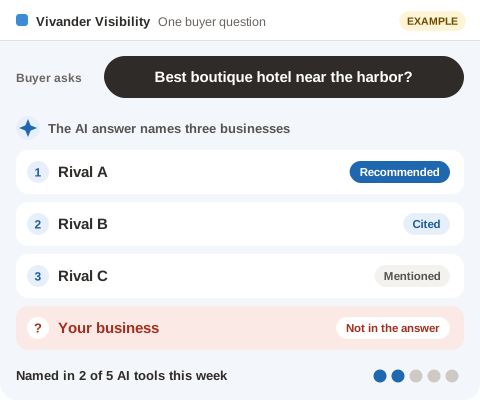
We ask your questions on five AI engines (six on Advanced, and add-ons for any plan) and score whether each answer mentioned, cited or recommended your brand.
The dashboards and the opportunities feed show where you appear, where you are missing, and what to change.
How do I set up my first run?
- Open Websites.
- Click Add website. Enter business name, domain, industry vertical, and location.
- Add questions. At signup we suggest them from a short description of the business; on Prompts you can add starter prompts or your own.
- Start a run with run credits, or wait for the website's next weekly cycle.
- Open Dashboard to see your Live Visibility Score, citation ledger, and competitive landscape.
How long does a run take?
A cycle asks every question in your plan, scored, watched and brand, on every engine in the plan. Each question is asked three times per engine.
An on-demand run takes credits counted from its size. One credit covers the Pro plan's 27 scored and brand questions on five engines.
A bigger run takes more credits, stated before it starts. Credit prices are on Pricing.
What engines do you support?
Seven. ChatGPT, Google AI Overviews, Google AI Mode, Gemini and Perplexity are in every plan.
Advanced adds Microsoft Copilot. Claude can be added to any plan at our cost, and Agency and Enterprise include it, as the pricing page shows.
Scores are computed over the engines that ran, and the platform records any engine it dropped and why.
Grok is not monitored.
Every page explained
What each page of the platform does. Pages marked admin only are hidden in client view.
Dashboard
The home screen. Every tile and donut slice drills into detail. It shows:
- A summary strip: VSS, Unbranded Visibility, Share of Voice, Avg Position, Platforms, Positive Sentiment
- A Metric Explorer with four tabs: Visibility, Share of Voice, Position, Sentiment
- The prompt-type drill-down, citation ledger, competitive landscape and Bridge Entities
Websites
Every website you track. Add, rename, set run cadence, seed the query library, trigger an immediate run.
A banner shows "using X of Y included websites on your [plan] plan," so you always know what is billable.
Prompts
The prompt list per website: the literal questions we run on each AI engine. Add, edit, remove, or bulk-seed from the industry library.
Prompts used in any past run are locked so the benchmark stays consistent week to week. To change direction, add a new prompt.
Assessment
The deep view. Every card on this page drills into a detail view. It shows:
- Your Visibility Stack Score in a ring chart
- Your score band: Invisible, Reactive, Structured, Integrated or Optimized
- Three pillar cards: Citation Rate, Recommendation Rate, Platform Spread
- A per-prompt table with tier, sentiment and citations for every run
Opportunities
The highest-value changes you can make, ranked by predicted lift. Filter by client, status, or pattern.
Each one ties back to a pattern (third-party listing gap, brand-query weakness, missing schema) with a concrete fix.
Competitors
Brands you track for side-by-side AI visibility. Each competitor is set to one of three tracking levels, which are settings for that competitor, not plans:
- Basic: compares the competitor with you on your own questions.
- Intelligence: adds monitoring of their pages, with a timeline of each change found.
- Premium: adds an AI reading of each change and a summary of their business.
Click View details on any competitor for tracked pages, change timeline, and intel feed.
Billing
Stripe-backed account management. See your plan, payment method and invoices, change plan, buy run credit packs, or cancel.
Plan and credit prices are listed on Pricing.
Costs (admin only)
API spend for each run, broken down by engine and by run date. Hidden in client view.
Leads (admin only)
Inbound leads from the public lead-capture page.
Admins can update status, leave internal notes, resend confirmation emails, and escalate to the tenant owner.
Invite (admin only)
Invite a new user to your tenant (owner / admin / member / viewer).
Invited users receive a secure sign-in link by email. No password is required.
About & Methodology
The INVISIBLE framework, the Answer Spiral, the five score bands, how we calculate each KPI, and what we do and do not do.
Metrics & scoring
One score built from four layers, and the words used for each answer.
What is VSS?
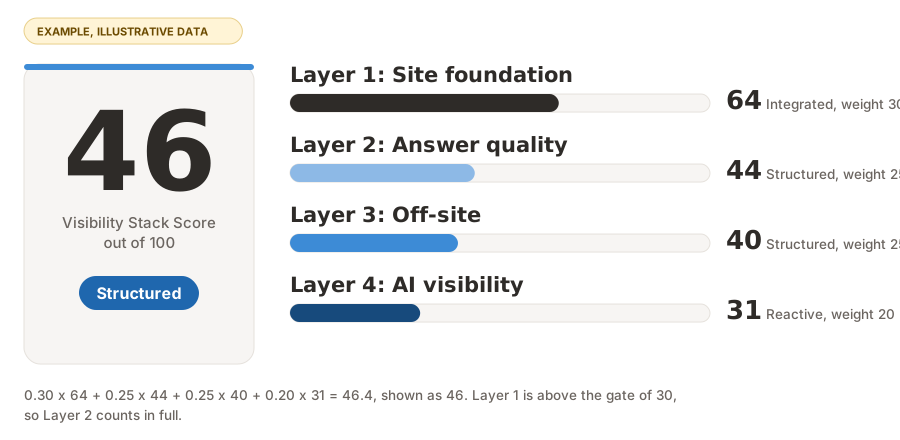
The Visibility Stack Score, 0 to 100, built from four layers. Brand prompts never enter it, because they always mention you.
It is the diagnostic score, set when an audit is run. The platform tracks the Live Visibility Score every cycle.
- Layer 1, site foundation: 30%
- Layer 2, answer quality: 25%
- Layer 3, off-site corroboration: 25%
- Layer 4, AI offered rate: 20%
When Layer 1 is under 30, a soft gate scales the Layer 2 contribution down. AI cannot quote a page it cannot reach.
The methodology explains each layer and the gate. The band color tells you where you are:
- 0 to 19 Invisible: AI does not know you. Fix corroboration (press, directories, Wikipedia, third-party listings) before the website.
- 20 to 39 Reactive: Sporadic mentions, no consistency. Fix on-site infrastructure (schema, sitemap, crawler access).
- 40 to 59 Structured: Mentioned, rarely cited. Add differentiation signals (awards, category authority).
- 60 to 79 Integrated: Cited, not yet the top pick. Compete on freshness, sentiment, share of voice.
- 80 to 100 Optimized: You win most answers. Defend the position.
What's the difference between "mentioned", "cited", and "recommended"?
- Invisible: Not mentioned at all.
- Mentioned: Named in passing, no endorsement, no source link.
- Cited: Named with a URL or an explicit source attribution.
- Recommended: Explicitly endorsed as a top choice or best fit. Requires positive sentiment.
"I'd recommend contacting them" is deflection. It does NOT count as an endorsement.
What is Unbranded Visibility?
The percentage of non-brand prompts where your brand appeared (mentioned, cited, or recommended). It is the headline answer-engine-optimization (AEO) metric.
It answers one question: can AI find you when someone is not searching your name?
What is Share of Voice?
Of unbranded prompts where a visible mention occurred, how often only you were mentioned, with no competitor alongside.
Higher means AI prefers you over alternatives.
What does Position mean?
Where your brand appears in the AI's list: top (first in the ordered list), middle, or bottom.
It is set by where we first detect the brand name in the response text.
What is a Bridge Entity?
A local landmark, attraction, or adjacent competitor that creates demand in your market.
"Hotels near Bryant Park" is a bridge query. Whether AI connects you to Bryant Park decides if you capture that demand.
Bridge prompts live in the bridge bucket on /queries.html.
How are citations classified?
Our domain classifier gives every URL the AI cites a source class:
review_platform(WeddingWire, TheKnot, Yelp)social(Facebook, Instagram)ota(OTAs like Booking.com)wikipedia,government,news,blog,directory,video,official_site, orother
Assessment & baseline
Your first completed cycle becomes the line every later result is measured against.
What is a baseline?
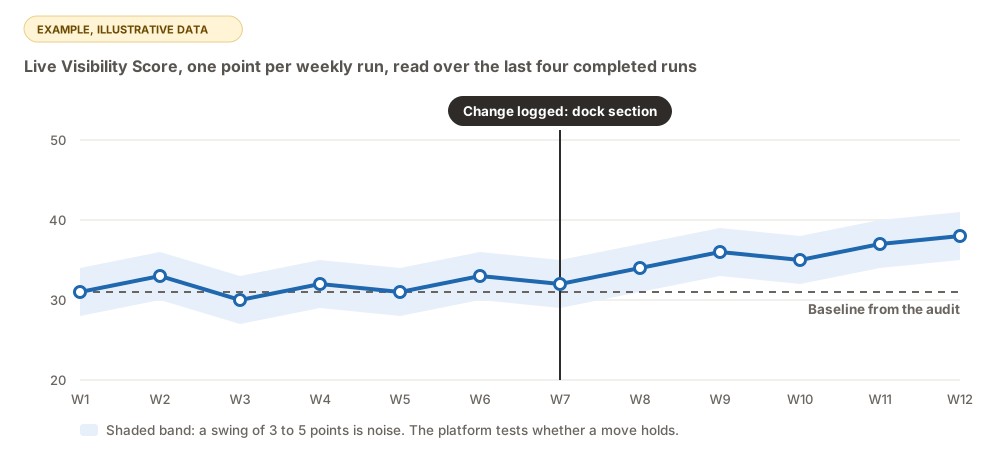
Your baseline is the frozen result of your first completed cycle.
It records your VSS, pillar scores, score band, and the exact cohort of prompts that produced those numbers.
Every later data point on the assessment page is measured against it.
A change such as VSS went from 11 to 23 then means real improvement, and not "we asked different questions."
How is the baseline captured?
Automatically. When your first cycle completes, we snapshot its non-brand prompt results into a locked baseline. Nothing you need to do.
The prompts that made up that first run become your benchmark cohort.
Can the baseline change?
The cohort can be expanded by adding new prompts. It is never shrunk.
This protects the trend line while the benchmark grows with your business. Locked prompts keep their original text regardless.
How often does the assessment re-run?
Every website gets one baseline, captured on its first completed cycle. After that, scheduled cycles follow the cadence set for the website.
An on-demand run takes run credits counted from its size, stated before it starts. When the balance is short, the run is refused and you are asked to buy a credit pack.
Why does my baseline say Level 0 / Invisible?
Most businesses start here. It means AI platforms rarely surface you on unbranded queries.
That is normal, and it is the starting point the tool is designed to move you away from.
See score bands for what each band means.
What happens if I want a new baseline?
Contact support. Resetting a baseline erases your trend line, so we treat it as a deliberate action rather than a self-service button.
Usually this is done only after a major site overhaul or rebrand, when the old benchmark no longer means anything.
Prompts & runs
How many prompts should I run?
Your plan sets the number. Starter covers 50 questions, Pro 150 and Advanced 250, each the same 24 scored questions plus watch questions.
Every plan also asks 3 questions that name your business. They are reported apart and never scored.
Why are some prompts locked?
Once a prompt has been used in a run, its text, bucket, and priority are frozen. This keeps the benchmark consistent from week to week.
If the wording of an old prompt changed, comparing this week's score to last week's would mean nothing.
To track something new, add a new prompt. You can still deactivate a locked prompt so it stops running without affecting history.
Why does the same prompt produce different results on different days?
In testing, we observed that AI answers vary between tries. So every question, scored or watched, is asked three times on every engine, every cycle.
Two answers out of three decide each result, and scores are shown with intervals.
Wide intervals mean the metric is directional. Narrow intervals mean it is reliable.
Why ask three times in one day instead of once a day?
An AI answer is probabilistic, not deterministic. One answer is one sample, and it may not be the usual answer.
In testing, three same-day asks disagreed on naming the business in about 1 in 7 question and tool pairs, and in 1 in 3 where it was named at all.
One ask a day cannot see that split. On a split question, a daily line flips between named and not named, and that reads as movement.
Three asks on one day show whether a question is settled (three of three) or contested (two of three).
Every engine is asked in the same weekly run, so a gap between engines is not a gap between days. Week against week then measures change.
What are prompt "buckets"?
- brand: Direct brand queries, such as "Tell me about Wentworth Weddings."
- service: Specific offerings, such as "Who does outdoor wedding ceremonies in NH?"
- category: Best-in-category, such as "Best boutique hotel in Manhattan."
- persona: Written in the voice of a specific buyer type, such as "Wedding venue for a business traveler."
- bridge: Local landmark comparisons, such as "Wentworth vs Cliff House Maine."
- problem: Problem-solution, such as "How do I plan a destination wedding in NH?"
Competitors
What does "tracking a competitor" actually do?
It depends on the tracking level set for that competitor:
- Basic counts the competitor in the answers to your questions, so Share of Voice and the competitive presence charts include them.
- Intelligence adds monitoring of their pages. Each change found is logged on the competitor's timeline.
- Premium adds an AI reading of each change, to estimate its effect on AI answers, and a summary of their business.
How many competitors should I track?
Each website can track up to 5 competitors at Basic, 10 at Intelligence and 5 at Premium. Each level has its own limit, and only competitors that are not paused count.
Start with direct substitutes rather than upmarket alternatives. A comparison works only when the same buyer considers both.
Opportunities
Each opportunity moves through a status as your team works on it.
No one has started it.
You or your team took it on.
The fix shipped and the next run showed improvement.
Where do opportunities come from?
The opportunity generator runs nightly over the prior day's runs.
It emits action items grouped by pattern: third-party listing gap, brand-query weakness, schema gap, content gap.
Each one carries:
- A predicted-lift estimate (the number of queries that would improve)
- An effort level: low, medium or high
- Its pillar: Infrastructure, Narrative, Verification, Inclusion, Social proof, Inbound links, Blocks, Local or Entity
How do I know which opportunities to tackle first?
Sort by predicted lift (the default). Low-effort, high-lift items come first.
If your VSS is in the Invisible band, put opportunities tagged verification, inclusion, or inbound links first.
Those raise the score fastest when AI doesn't know you.
What does "status" mean on an opportunity?
- open: Waiting for action.
- in_progress: You or your team started it.
- validated: Fix shipped and the next run confirmed improvement.
- closed: No longer relevant.
- dismissed: You've decided not to pursue it.
Assistant chatbot
What is the lightbulb in the bottom-right?
The Vivander Assistant. Click it to open a chat panel.
The assistant sees whatever page you have open and knows your data: your VSS, your top missed queries, your tracked competitors.
Ask "what am I looking at?", "why is my VSS what it is?", or paste a competitor's URL and ask "what do you see here?".
Can I attach a URL or a screenshot?
Yes. Use the link icon to paste a URL (the assistant fetches and reads it). Use the image icon to upload a screenshot (up to 5 MB, PNG/JPEG/WebP).
Raw images are not stored in the database; only metadata persists.
Do my messages persist?
Yes. Each conversation is a thread tied to your user account. Close the browser, come back tomorrow, and pick up where you left off.
Start a new thread any time with the New button in the panel header.
Plans & billing
What plans are available?
Three monitoring plans (Starter, Pro and Advanced), Bring Your Own Answers, and Agency and Enterprise, which are built to order.
Every monitoring plan gets the same locked core of 24 scored questions, every score, every page, every answer and every export.
Every question is asked three times on every engine, every week. Plans differ in how many questions they cover and which engines run:
- Starter: 50 questions on five engines
- Pro: 150 questions on five engines
- Advanced: 250 questions on six engines, adding Microsoft Copilot
- Bring Your Own Answers: you upload the AI answers you collect, and we score them. 300 answers a month are included.
- Agency and Enterprise: built to order
A custom plan from Build your plan is priced from our measured cost. Prices are on Pricing, read live from billing.
Starter, Pro and Advanced are billed monthly or yearly, with a discount off the monthly price by the year; the pricing page shows both. There is no free trial.
What happens when I run out of run credits?
An on-demand run is refused with a message to buy a credit pack. Nothing is billed automatically.
Every score and answer already collected stays viewable. Credits do not expire.
How do I get started?
Create an account and confirm your email. Your account opens, and you start the plan you chose. Nothing is charged before that.
Sign up with your business email address, the one at your company's own domain; free email providers such as gmail.com are not accepted.
The website's first completed cycle is its baseline. There is no free trial.
How do I cancel?
Open Billing, click Manage subscription (opens Stripe Customer Portal), click Cancel.
Access continues until the end of the current billing period.
Team & admin
What roles exist?
- owner: Full access; receives escalation emails.
- admin: Full access; can invite others; can escalate to owner.
- member: Full non-admin access.
- viewer: Read-only.
How do I invite a teammate?
Open Settings and use the Team card. Enter their email and choose full access or read-only. An owner or admin of the account can invite.
Every plan includes unlimited team members with full access, and unlimited read-only viewers. The price does not change with the number of people.
The Invite page is for Vivander administrators opening a new client account. It does not add anyone to yours.
What does "Escalate to owner" do on a lead?
Admin-role team members can flag an inbound lead as urgent.
The account owner(s) receive an email with the lead summary, any note you added, and a deep link to the lead in admin-leads. The lead row gets a red URGENT pill.
Re-escalating keeps the original timestamp and re-sends.
Data & privacy
Where is my data stored?
A secure, encrypted database hosted in the United States (Oregon).
Strict per-account isolation keeps every customer's data separate. Your runs, queries, opportunities, and threads are never accessible to other customers.
The services that process your data on our behalf are listed in the Privacy Policy, section 4.
What happens to my data if I cancel?
The dashboard becomes read-only and new runs stop.
Existing runs, opportunities, and competitors are preserved for 30 days, then deleted (GDPR-compliant data minimization). One reactivation email goes out on day 30.
Can I export my data?
Yes. Exports are included on every plan, not held back for a higher tier.
The answers feed exports every answer verbatim with its tier, sentiment, position and citations.
Tables export to CSV, and a full data export downloads everything for a website as one zip of CSV files. There is no API access.
Troubleshooting
My score is 0. Is that broken?
Almost certainly the score is real. A score of 0 means no non-brand question returned a cited or recommended answer over the last four completed cycles.
This is the Invisible band, and it is common for businesses that haven't done AEO work.
Fix corroboration (third-party mentions, directories, Wikipedia) first. On-site SEO won't help until AI has multiple sources to pull from.
The dashboard donut is all one color.
Hard refresh (Ctrl/Cmd + Shift + R).
We ship CSS and JS updates with versioned URLs, and an older cached copy sometimes lingers behind a CDN layer.
A run says "running" for more than 10 minutes.
The run worker reports back to visibility_audits.status.
If it still says running after 15 minutes, check Costs. An engine that hit its rate limit (most often Gemini) shows zero cost for that engine's rows.
Contact support and we will re-queue it.
I changed my industry but the prompt library didn't update.
Expected. Existing prompts stay as-is (locked). To use the new industry's library, open Prompts and click Seed from library.
It adds the new industry's prompts on top of what you already have, skipping duplicates.
I don't see my tracked competitor's changes.
Page monitoring runs only for competitors at the Intelligence or Premium level. The AI reading of each change runs only at Premium.
A competitor added recently shows changes after its pages have been read twice. The competitor's detail page shows "Last crawl", when we last looked.
Still stuck?
Click the lightbulb in the bottom-right of any authenticated page. The assistant sees your current page and knows your numbers.