
What every plan includes
Start from what does not vary. Every plan gets the same measurement method and the same pages.
A baseline for every website
Each website's first completed cycle is kept as its baseline: the fixed question set and the scores computed from it, frozen when captured.
Everything the platform later shows as movement is measured against that baseline.
The same pages on every plan
- The Assessment page carries the baseline and the trend against it.
- The answers feed carries the raw AI answers behind every number. Any score traces back to the exact response behind it.
- Prompts, competitors, opportunities, the scorecard and the change log are on every plan.
A plan sets which AI engines are asked, how many questions are scored and how many more are watched.
It also sets how often the cycle runs and how many websites are included.
The plan is written to each website as its monitoring plan (client_monitoring_plans). The pipeline asks only the engines in it.
An extra website on Pro or Advanced may be measured at Starter depth instead, for its own monthly price. Its monitoring plan is then the Starter plan: 24 scored and 26 watched questions on the five AI tools without Copilot.
The tenant's plan_tier is read in two places that change what you get:
- the handler that adds a website (
POST /api/clients), for the websites included and the cap; backend/src/routes/queries.jsfor watch breadth.
No page, no score and no export is gated on the plan.
The plans side by side
Three plans where we collect the answers, and Bring Your Own Answers, where you upload them. Agency and Enterprise are built to order.
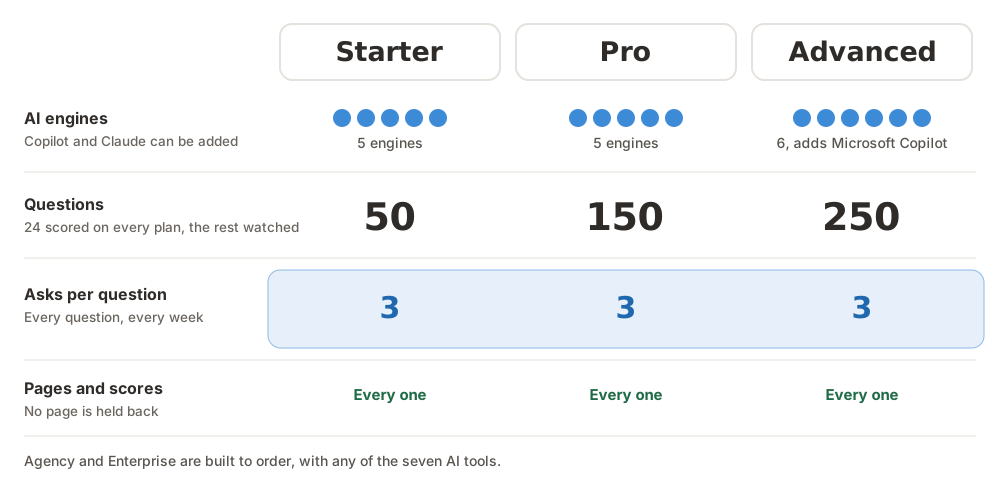
Every figure in the table is read from the pricing model (config/plan-pricing.json through backend/src/lib/plan-pricing.js) when the page loads.
Starter, Pro and Advanced are set prices, chosen to compete and always above the measured cost of their answers.
A custom plan from Build your plan is priced from that measured cost plus a share of the platform cost, with a monthly minimum. Checkout charges the same numbers.
| Plan | Engines included | Not included | Questions | Cadence | AI answers a month | Monthly, one website |
|---|---|---|---|---|---|---|
| Starter | Loading | |||||
| Pro | Loading | |||||
| Advanced | Loading | |||||
| Bring Your Own Answers | Loading | |||||
| Agency | Built to order | |||||
| Enterprise | Built to order | |||||
Agency and Enterprise are priced with the same model, from the websites and engines they measure.
An account opened before 6 October 2026 may hold an earlier plan. The Billing page shows the plan each account holds.
AI engines
Seven engines are supported: ChatGPT, Google AI Overviews, Google AI Mode, Gemini, Perplexity, Claude and Microsoft Copilot.
Starter and Pro ask the first five. Advanced adds Microsoft Copilot. Copilot and Claude can be added to any plan; Agency and Enterprise include both.
- Google AI Overviews and AI Mode are read from Google's search page at 0.4 cents a search, which is why both are in every plan.
- Claude costs the most per answer. No data provider sells its answers at a flat rate, so we ask Claude directly and pay for each page it reads. It is priced at that cost.
- Microsoft Copilot is priced from its own measured runs, about 1.5 cents an answer.
A website is measured on the engines in its plan, narrowed to the engines the account may run (tenant_engine_addons).
Every engine left out is recorded with the reason.
Platform Consistency and Visibility Rate are computed over the engines that actually ran. Two websites on different plans are measuring different surfaces.
The methodology page explains what each component does with the engines it is given.
Run credits
A plan measures on its own schedule. A run credit pays for a run you start yourself outside that schedule.
Credits are added to an active plan. An account with no plan, or a lapsed subscription, cannot buy them.
The plan carries the cost of running the account, and a credit is priced on run cost alone.
What one credit covers
One credit covers a run of the Pro plan's scored and brand questions on its five engines, asked three times. A run takes the credits its own cost needs.
A run measures the scored and brand questions when a website has a cohort. Otherwise it measures the whole ready question library.
- Loading examples
Credits are added to an active plan and do not expire. Buy them from the Billing page.
Pack prices come from creditPricing in backend/src/lib/plan-pricing.js: never more than 10 percent off, and never under twice the cost of the credits.
When the balance is short
The run is refused. The refusal names the credits needed, the balance, and the questions and engines. Nothing is queued or consumed.
A run that cannot be started after the credits were taken is refunded in full.
How often runs happen
Starter, Pro and Advanced measure each week. A custom plan can measure every two weeks or monthly instead.
- Each website follows the cadence its plan was sold at, and we set its schedule to match when the plan starts.
- The scheduler checks every hour and starts each website whose cycle is due, so cycles land about a week apart.
- A paused website runs nothing until it is resumed.
There is no daily or real-time monitoring. A run outside the schedule uses run credits.
One core cohort for every plan
The locked cohort, the four-cycle window and the intervals are running on the platform (backend/src/services/cohort.js, backend/src/lib/cycles.js, migration 087).
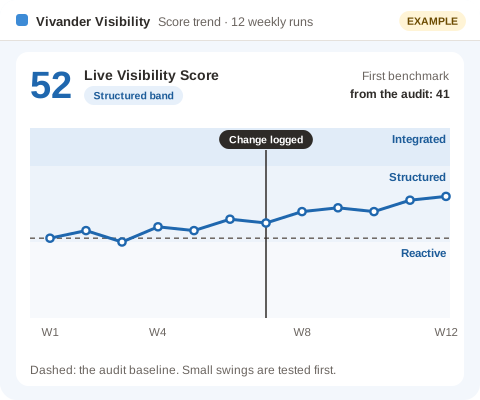
A website's first completed cycle under this rule is its baseline, and its live score starts from that cycle.
The same care on every plan
Measurement quality is not held back by plan. A smaller client's score has to be as trustworthy as a larger one's.
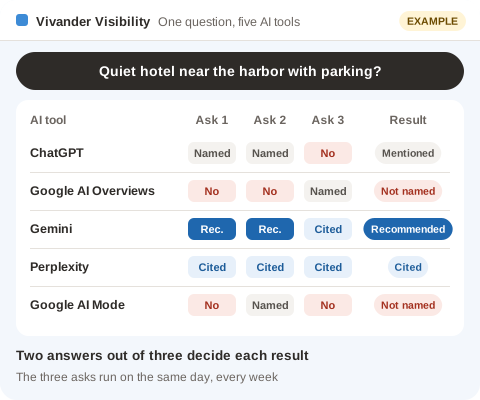
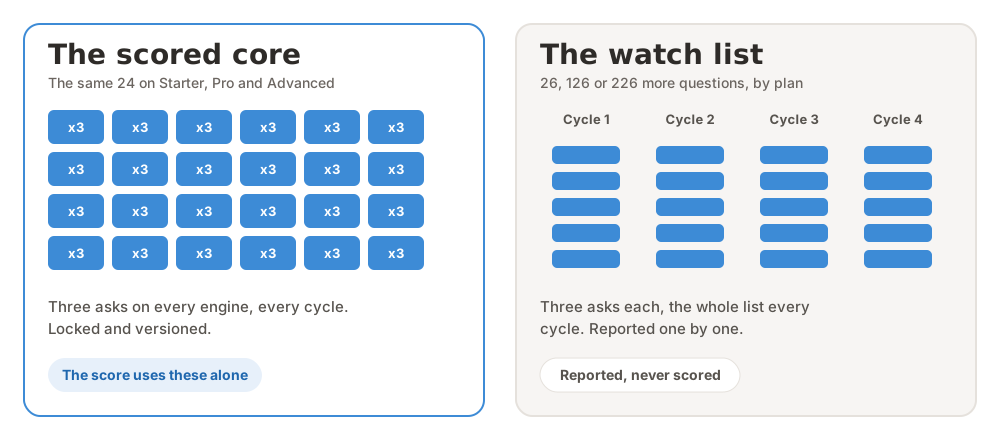
So every plan asks every question, scored or watched, three times on every engine, every week. The headline score uses the core cohort alone.
In testing, we observed that AI answers vary between tries. Two answers out of three decide each result.
- Every sold plan scores the same 24-question core, so scores compare across plans. Starter adds 26 watch questions, Pro 126 and Advanced 226.
- The core is drawn from the diagnostic's persona-by-intent grid at the highest commercial weight.
- It is locked and versioned. A change to it writes a new version with a reason and a marked break on the trend chart.
What differs by plan
Breadth differs: the number of scored questions, the number watched beside them, the engines and the cadence. The plan table above states each one.
Watch prompts feed the per-prompt view, the drop-off tiers and the answers feed. They enter no composite.
That keeps the headline number comparable between a Starter customer and an Advanced customer measuring the same brand.
Watch prompts are asked three times too
A watch prompt is measured on the same instrument as a core prompt: every platform you have enabled, with retrieval on.
Since framework v3.79, a watch prompt is asked three times per platform per cycle, like a core prompt. Two answers out of three decide each result.
A watch reading is reported question by question and enters no score. Moving a prompt into the core starts a new cohort version.
The window
The score is computed over the last four completed weekly cycles rather than a sliding calendar window.
The number changes when a cycle lands and at no other time.
What running the measurement costs
A custom plan's price is computed from the answers a month it asks, times each engine's measured rate, plus a share of the platform cost.
The three standard plans are set prices, held above that same cost.
The measured rates come from audit-pipeline/run_audit.py.
Microsoft Copilot carries its own measured rate, about 1.5 cents an answer.
The earlier arithmetic is in docs/measurements/monitoring-cost-2026-09-06.md.
The methodology page covers the monitoring in full: the surface, the cycle, the window, the seven components and how uncertainty is shown.
Design of record: docs/superpowers/specs/2026-09-05-deterministic-monitoring-design.md.
Build plan: docs/superpowers/plans/2026-09-05-deterministic-monitoring-plan-2-cohort-and-window.md.
The core cohort of 24, the locked and versioned cohort, and the four-completed-cycle window are specified there.
The watch counts of the legacy tiers are the founder decision of 5 September 2026 (WATCH_BREADTH in cohort.js).
The sold plans watch what their preset in config/plan-pricing.json says.
Changing your plan
Plans are chosen on Billing.
- An account with no active subscription starts one through Stripe Checkout, choosing the number of websites there.
- An account with a subscription manages payment details and cancellation in the Stripe billing portal.
- To switch plans, ask us, so the change is dated on every trend chart.
- Run credits are bought on the same page, on top of an active plan.
- Buying credits does not change the plan, and changing the plan does not change the credit balance.
Payments are processed by Stripe, and the platform never holds card details.
Click the lightbulb in the bottom-right corner. The assistant knows how many websites are on the account and what the current plan is.
For how the scores themselves are computed, read our approach. For everything else, the FAQ.