
The AI tools we ask, and how often
Each AI tool is its own measurement. Your plan names the tools it asks and the ones it leaves out.
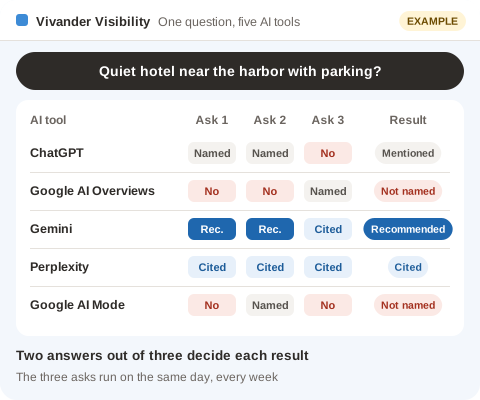
Every question is asked three times on every tool, every week, because AI answers vary between tries.
Where your buyers ask
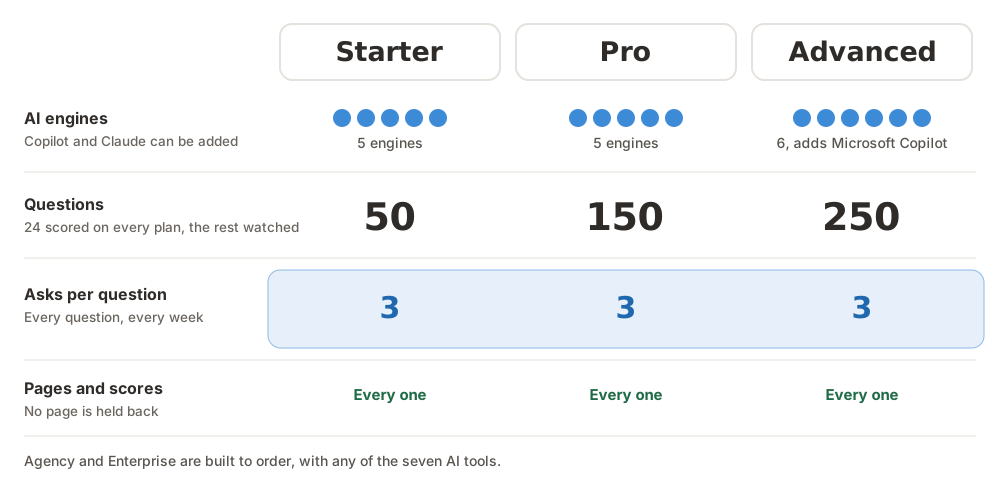
Google AI Mode is in every plan, as it is in the audit. Grok is not monitored.
The answer a buyer would get that day
A new chat each time
No memory of earlier questions, so one answer cannot steer the next.
The current model
We read ChatGPT and Gemini on their public websites, the way a buyer sees them. Each answer records the model behind it.
Web search on
Where the tool searches the web for a buyer, it searches for us too.
When a tool changes its model, the change is marked on your trend, so a jump is never mistaken for your work.
Cycles, and the window the score reads
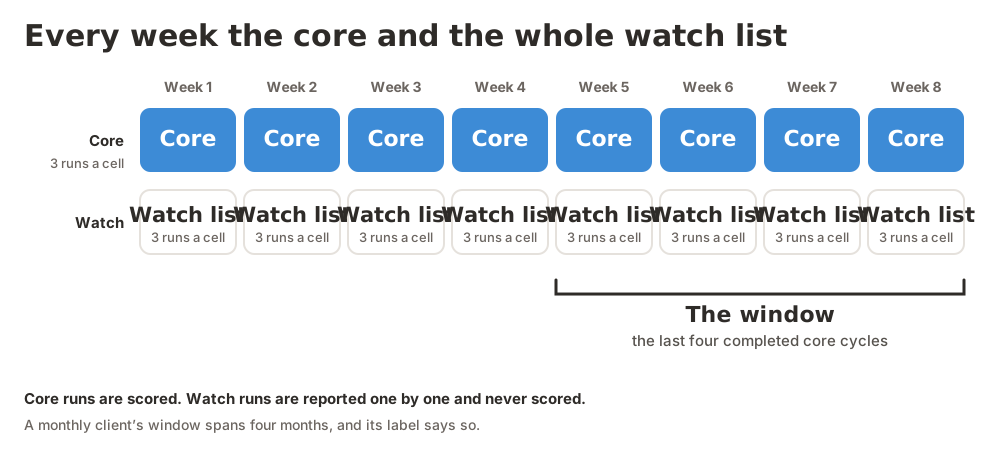
- Every question, scored or watched, is asked three times on each tool, in three separate passes.
- Two answers out of three then decide the result for that question and tool.
- Starter, Pro and Advanced all measure every week. A custom plan can measure less often.
Three asks on one day, not one ask a day
An AI answer is a draw, not a fixed result. Ask the same question again and the answer can change.
A search ranking is deterministic: the same query returns the same page. An AI answer is probabilistic, so one answer is one sample.
1 in 7
Question and tool pairs where three answers on the same day disagreed on naming the business.
1 in 3
The same split, counted only where AI named the business at least once.
42%
Pairs naming rivals where all three answers named the same rivals.
In testing, we observed these splits across 2,162 question and tool pairs in five audits, with nothing changed between the asks.
One answer cannot tell you whether it is the answer
A tool that asks once a day sees one of those three answers. It cannot tell a settled question from a split one.
On a split question, a daily line flips between named and not named. That looks like movement. It is chance.
Three asks on the same day show the split itself. Three of three is a settled answer. Two of three is a contested one.
A contested question is a finding: AI has not settled on you there, and that is where work moves the result.
What two of three is worth
Say an AI tool names you on most tries. How often does one reading say you were left out?
| The tool names you | One ask reads you as left out | Two of three reads you as left out |
|---|---|---|
| 9 tries in 10 | 10% of readings | 3% of readings |
| 8 tries in 10 | 20% of readings | 10% of readings |
| 7 tries in 10 | 30% of readings | 22% of readings |
The arithmetic assumes each ask is independent. That is why the three asks run in three separate passes, never back to back.
Every tool in the same window
Every AI tool is asked in the same weekly run. A gap between ChatGPT and Gemini is a gap between tools, not between a Tuesday and a Friday.
Weekly, compared over four weeks
Three asks on one day measure how much answers vary. Comparing week to week then measures change.
One ask a day mixes the two. Seven answers on seven days blend chance with real change, and nothing in them separates the two.
A once-a-day tool collects more answers, seven a week to our three. The count is not the point. The design is.
The score reads the last four weeks: 12 answers per question on each tool. A move counts only when it clears that variation.
See the approach on your own market.
Start full monitoring, where we ask the AI tools for you, or upload answers you already collect.