
Invisible: What to Do When AI Erases Your Business
Customers now ask AI where to go, what to buy and whom to hire, and many act on the answer they receive.
Michael J. Goldrich's book explains how that shift works, how to measure where your business stands in those answers, and what to fix first.
By Michael J. Goldrich. Published by Vivander Press, 2026.
A working manual for discovery inside AI answers
For twenty-five years, people found businesses by scanning a list of links.
AI platforms such as ChatGPT, Gemini, Perplexity and Claude increasingly answer directly, with a short list of named businesses and a reason for each.
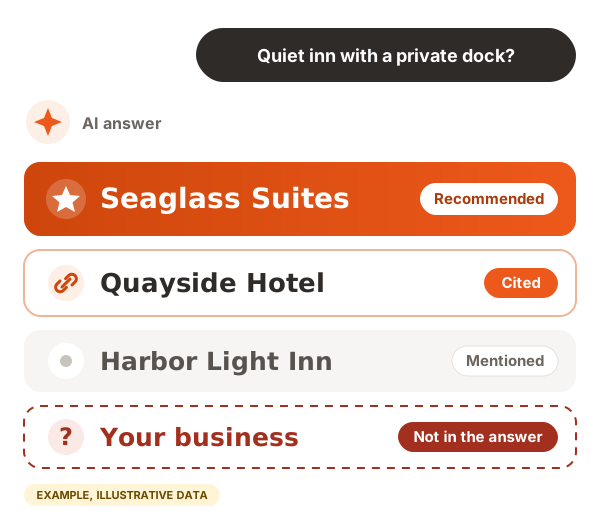
A business left out of that answer is unlikely to be considered.
Invisible treats that change as a measurement problem and an operating problem. It explains:
- How AI platforms gather and weigh information
- Why web analytics cannot see most AI-driven discovery
- How to score your own visibility with a repeatable test
The book then sets out the work:
- The technical foundations of your website
- The third-party sources AI relies on
- An implementation sequence
- The governance that keeps the gains in place
Most examples come from hotels, because unsold rooms cannot be sold later and discovery failures show up quickly in revenue.
Readers in other fields are asked to read "property" as "business" and "guest" as "customer."
The book walks through the same mechanics for a law firm, a retailer and a restaurant.
The chapters translate technical concepts into business consequences.
The appendices hold the schema guide, testing protocol and templates for the people who build the work.
Who should read it
Owners and general managers
People who need to know whether AI platforms recommend their business, what that absence costs, and which work to fund first.
Marketing and commercial leaders
Teams whose reports show strong search rankings and steady social engagement, and who still cannot explain where AI-driven demand is going.
Agencies and advisors
Firms that need a common score and a testing protocol they can run for several clients and explain to each of them.
What the book covers
Ten chapters move from the problem to the measurement to the work. A conclusion, an epilogue on AI agents that complete purchases, and seven appendices follow.
How AI answers change discovery, and why analytics miss it.
A five-level ladder from Invisible to Optimized.
Your website, and the sources AI reads about you.
The score, the roadmaps and the governance.
The Discovery Crisis
How AI answers replace the list of links, using published research on how often searches now return AI summaries.
It introduces query fan-out, where one question becomes several background searches, and the head start that large global brands carry into every answer.
The Measurement Gap
Why web analytics miss most AI-driven discovery.
A buyer can move across many platforms before a booking or purchase, and the AI conversation that started the journey rarely appears in any report.
The Answer Spiral Replaces the Funnel
Awareness, consideration and conversion still happen, compressed into one conversation and revisited many times.
The chapter describes how buyers circle from broad questions to specific ones and back again.
The Walled Garden Problem
Social following and platform engagement do not carry over into AI recommendations.
Each platform retrieves information in its own way, so resilience comes from being described consistently in many places.
Knowing Where You Stand
What to call this discipline alongside SEO, AEO and GEO, and a five-level maturity ladder from Invisible to Optimized.
Readers assess their own starting point before committing resources.
Technical Foundations and On-Site Optimization
Three layers an AI-readable website needs: text the server delivers without scripts, structured data, and clear content architecture.
It also covers bridge entities, the places and topics that connect a business to the questions buyers ask, and the page formats AI tends to quote.
Citation Networks and Off-Site Influence
Your website is one source among many, and AI weighs what independent sources say about you.
The chapter maps the trust hierarchy of reviews, directories, press and listings, and how to build consistent references across them.
The Visibility Score Framework
A 0 to 100 score built from five weighted components, measured with a 20-prompt test across the major AI platforms.
Scores map to the maturity ladder, so progress can be tracked from one test to the next.
Implementation Roadmaps
Sequenced plans sized to real staffing, starting with checks a team can complete in its first 48 hours.
The roadmaps sequence the work and set timelines to match the staff a business has.
Organizational Integration and Governance
How to keep visibility from fading when the person who championed it moves on.
The chapter covers ownership, standard processes and a regular testing rhythm that make the work a business function.
- Common objections
- A schema implementation guide
- The Visibility Score testing protocol
- A competitive intelligence toolkit
- Operational templates
- A glossary and a quick start guide
How the book became a measurement system
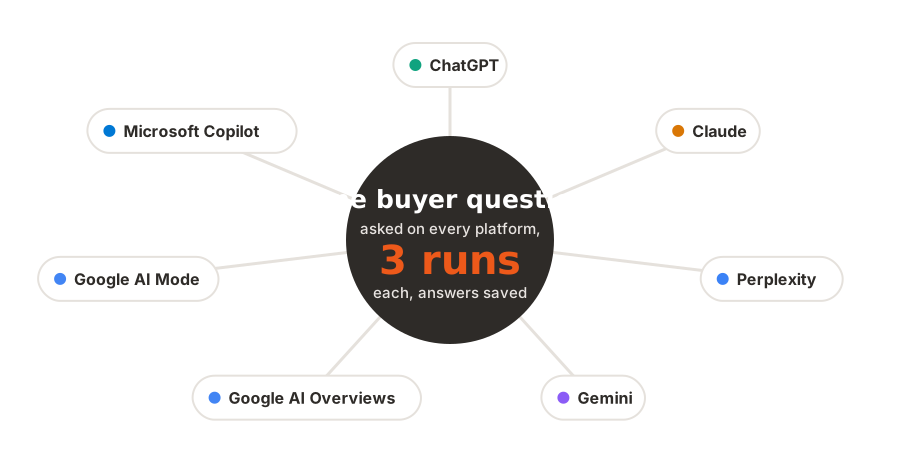
The book's Visibility Score was designed to be run by hand: twenty prompts, four platforms, a spreadsheet and screenshots.
Vivander built a measurement system to run the same test at a depth a spreadsheet cannot hold:
- More prompts, in the voice of your buyers
- More engines: up to seven AI platforms
- Several runs per prompt
- A record you can return to
Each idea carried over directly, as the table shows.
Together the four layers form the Visibility Stack Score. It uses the same five-band maturity ladder from Chapter 5.
| In the book | In the measurement system |
|---|---|
| Three technical layers (Chapter 6) | Layer 1, Site Foundation, and Layer 2, On-Page Answer Quality |
| Citation networks (Chapter 7) | Layer 3, Off-Site Corroboration |
| Visibility Score (Chapter 8) | Layer 4, AI Visibility, which every engine's answers feed, and the Live Visibility Score tracked every cycle |
| Maturity ladder (Chapter 5) | The five bands, Invisible to Optimized, printed beside every score |
| 20-prompt manual test (Appendix C) | A measurement: a buyer-voice prompt set on up to seven AI platforms, several runs per prompt |
| Governance rhythm (Chapter 10) | A repeated measurement: a locked core of prompts measured on a regular cycle |
The Visibility Stack Score's weights and components have been refined since publication. The weights in use today may differ from the printed ones.
Read it, then run it yourself
Learn the method
The chapters move from the problem to the measurement to the work.
Run the test
Run the 20-prompt test yourself and score the result. You get a directional view of where you stand and a plan for what to fix.
Keep the gains
Chapter 10 sets a regular testing rhythm, so the work becomes a business function and the gains stay in place.
AI answers vary from one run to the next. Every finding in the book describes what we observed in testing at a point in time.
That is why the measurement repeats each prompt and prints its sampling basis.
Michael J. Goldrich
Michael J. Goldrich founded Vivander Advisors after twenty years leading digital marketing and technology strategy in hospitality.
- Senior roles at Starwood Hotels and Resorts, Wyndham Worldwide and The Hotels Network
- Earlier, internet strategy for financial services clients at Andersen Consulting and Accenture
- Co-chair of the Hospitality AI Council at HFTP
- Co-lead of the Product Data Strategy and Analytics program at Northwestern University's Kellogg School of Management
- A column on AI adoption for Hospitality Upgrade
Find out where your business stands
Read the book to learn the method.
Its 20-prompt test shows where your business stands in AI answers today.